Showing posts with label Photography. Show all posts

3.30.2010

Sigma 85mm f/1.4 lens size specs


I fear I run the risk of sounding like all the iPad prognosticators I grow extremely tired of hearing, but I have a little more data on the upcoming 85mm f/1.4 lens from Sigma.

I was really interested in actual dimensions and weight on this lens for better comparison "on paper" with comparable lenses by Nikon and Canon in terms of handling. In response to a post I made on another forum, I was handed a link to lens specs that do include physical dimensions, but still nothing on weight. Here, we see the Sigma measures 84.7mm in diameter, and 87.6mm in length. Weight is listed as "TBD." One might guess that some materials are still not settled upon with finality, which could affect lens weight.

We can now see the Sigma is somewhat larger than the Nikon 85mm f/1.4 lens (80mm diameter and 72.5mm long) even considering Nikon's dimensions apparently do not include the lens mount flange. And Sigma comes in considerably smaller than Canon's f/1.2 hog, which measures 91.5mm diameter by 84mm long.
Sigma50mm1.4.png

This Sigma lens, along with their previously introduced 50mm f/1.4 lens (shown at left), seem targeted to hit Nikon and Canon at points in their lens line where they are weak. Nikon recently introduced an upgraded 50mm f/1.4 lens, and canonrumors.com reports rumblings that Canon is about to follow suit with a 50mm f/1.4 update of their own. Would either company be likely to make a move on this type of lens without non-OEM competition?

How the Sigma lens will compare optically is a completely open question, since virtually nobody, save possibly for a few chosen souls covered by NDA, has shot with one yet. The added bulk of the Sigma compared to the Nikon lens may be explained by the HSM focusing motor, and will very likely be justified by better performance of the AF. The size reduction compared to the Canon offering will also with near certainty be accompanied by improved AF and MF performance at the paltry cost of 1/3 stop of light gathering power. (The f/1.2 max aperture serves Canon better in terms of bragging rights and profit margin than it does users in terms of usable lens aperture.).

While I enjoy and appreciate the faster apertures and (often) better optics of fixed lenses compared to their zoom counterparts, I don't own any right at this time and choose to rent them as needed, as Robert's Distributors in Indianapolis is a readily available source for me. I am normally reticent to go with non-OEM optics but Sigma has my attention with the 50mm f/1.4 and the 85mm f/1.4. It is impressive to me that Sigma is competing directly on lens build quality and performance and not just on price. Their 50mm is actually pricier than Canon's and about the same price as Nikon's. The Sigma 85mm will pleasantly surprise me if it comes in much below $1000.00 US, which would be lower than Canon's price and roughly the same as Nikon.. Whether or not I end up buying one or both of these lenses, I appreciate Sigma's mixing it up in the fixed-length marketplace.

3.24.2010

Sigma 85mm f/1.4 update

I heard back today from Sigma on my information request about their upcoming 85mm f/1.4 lens. They told me that can't give more detailed information at this time on precise dimensions and weight of the lens, so I still can't do a direct comparison with the Nikon and Canon equivalents of this lens.

However, they did burst my bubble somewhat by stating this lens will NOT be compatible with a teleconverter. I was salivating a bit at the prospect of a single lens/converter combo that could obviate my need to periodically rent Canon's 85mm f/1.2 and 135mm f/2.0. If there were a matching 1.4X teleconverter, this lens could be both a very fast 85mm and a 119mm (which is close enough to 135mm).

Such is life. Hopefully Sigma will change their minds on this and issue a compatible converter, but I will continue to breathe normally in the interim.

3.19.2010

Sigma 85mm f/1.4 HSM. Sweet.


Sigma, long a competitor in the pro-sumer zoom lens market, has also shown it is not afraid to mix it up in the higher-end lens market. For several years they have had well-reviewed versions of 70-200mm 2.8 and 24-70mm 2.8 lenses. They have also pushed into fixed-length (see this post on why I hate the term "prime" - except when it's used properly) lens markets with 300mm 2.8, 50mm 1.4 and others. Soon (thought no date was given), their newest entry in their "fast and fixed" line will be the 85mm f/1.4 EX DG HSM lens.sigma85_1.4.png

In Sigma parlance, "EX" refers to the special finish and higher build quality on its higher-end products, and DG refers to a lens suitable for full-frame digital and film cameras (as opposed to "DC" lenses, which are only for "crop-sensor" cameras, such as Nikon D300 or Canon EOS 7D, to name a few). HSM refers to focus driven by Hypersonic Motor.

I have multiple times rented the Canon 85mm f/1.2L USM (both the original and the "II" versions) lens for specific occasions when I wanted insanely thin depth of field or was working in ridiculously low light, such as a local college dance group that seems fond of performing in near total darkness. The Canon is a great lens optically, but it handles like a shot put. In addition to being larger and heavier than seems necessary, both manual and autofocus are slo-o-o-o-o-o-o-ow. The "II" version improved handling compared to the original, but only incrementally. Sigma's new lens is shown here in a photo provided by the company, apparently in Canon mount. Based on the known dimension of the mount flange, this lens appears to by noticeably smaller than Canon's big-ass 85mm, while only being a measly 1/3 stop slower. I would also say it is somewhat more compact than the Nikon 85mm f/1.4.

Way back in the day (late '80's), when I was a Nikon shooter, I owned a Nikkor 85mm f/1.4 for a couple of years. This was also a great lens optically, though I could never master getting basketball action shots reliably in focus with it at f/1.4. I may not do a whole lot better with that today, as that is very sparse depth of field. Nikon's current autofocus version of this lens appears to be the same basic design, though it uses the old-style body-driven "screwdriver" type AF rather than the newer, more reliable "hypersonic" style motor. Sigma's new lens will almost certainly be a faster, more accurate, and quieter alternative for Nikon users.

Do I sound like I'm looking forward to getting my hands on this lens for a test drive? Well, yes, I am. While Canon OEM zooms are my bread and butter, I do like a fast fixed-length lens at times for certain purposes, and am not married to Canon glass only. Sigma's 50mm f/1.4 lens is very attractive to me, though I've not sunk the bucks into one yet. It is well-reviewed around the 'net, but for my work, the 50mm is more of a "would be nice" than a "must have." That scale may slide once there is a sustained improvement in the economy.

With it's greater reach, the 85mm could rate as a "must have" for my work, particularly with the aforementioned dance/stage events, and also with high school/college diving and dog agility events, both of which involve fast action under dodgy indoor lighting and usually a ban on electronic flash.

Sigma's press release does not specify if the 85mm is compatible with a 1.4X teleconverter. The lens would almost definitely be a "must have" for me if it was 1.4X-ready, as that would essentially give me a dual-duty lens that would also replace a 135mm f/2.0 lens, which is another lens I rent on a recurring basis for similar events. I have an inquiry in with Sigma at this time. Not surprisingly, information on exact release date and price are not being disclosed at this time, though I was told June is a target for release. I also asked about precise weight and dimensions of the lens for direct comparison with current equivalent Nikon and Canon lenses and if the Sigma 85mm to get a better idea of the handling and flexibility of the Sigma. I am told answers on these questions may come by Monday.

I'll let you know.

8.29.2009

Prognostication From A Dark & Smelly Place


I should probably start this entry by stating a few things that I am NOT. I am not an oracle or a psychic. I am not a Canon fanboy and am not in the Canon inner circle or connected with the company in any way. I am not a Canon evangelist or a Nikon detractor. (I have a spreadsheet calculating the cost/benefit of a switch to Nikon to prove that.)

Recently, a mole at Best Buy revealed new UPC product database entries had been created for the Canon G11, S90, and 7D. That a G11 was eventually coming is a no-brainer. The "G" series has updated on a more-than-annual basis for years.

The S90, on the other hand, is thought to be a much more counterintuitive development. I have to take other web posts at their word on this, since I do not follow developments surrounding this type of camera. But, if we accept that the S90 prediction was either based on fact or an exceptionally lucky guess, the 7D gets added credibility, as well as a blogospheric tornado of speculation on it's specifications.

To amalgamate the myriad estimations of 7D capabilities, the new camera will most probably:

• be anywhere from 12 to 21 megapixels.
• have one, or perhaps two, digic IV processors or debut a Digic V.
• do HD video up to 1080p.
• have a 3.9 framp-per-second shooting rate.
• or, maybe, 8 fps.
• or 5 fps. Who knows?
• slice.
• dice.
• chop.
• make julienne fries.
• cost about $2700.00 (body only).
• or around $1700.00.
• have built-in pop-up flash. Or not.
• employ an APS-C 1.6x crop sensor.
• Oh, never mind. It's full-frame.
• have 15 focus points.
• No, make that 19 focus points.
• why not one meeee-lee-uhn focus points?.
• give you oral pleasure.
• ISO 50 to ISO one meeee-lee-uhn.
• have weather sealing comparable to EOS 1D MkIII.

The preceding list, delivered with tongue causing a rug burn on the inside of my cheek, goes to show how useless any speculation, including my own, truly is. As the old saw goes, "Anybody who knows isn't talking, and anybody who's talking doesn't know."

But what the hay? Speculatin's fun.

I went on record with an email to my friend Ron Wise over a week ago with the following predictions for the 7D:

• 16-ish MP with one or two sRaw modes
• up to 1080p video
• motor at least 6.5 fps
• 1.3x crop
• "real" ISO ratings to 6400, with "cheats" up to 25K
• one CF and one SD card slot

As I read this a week later, I find I still agree with myself. Nothing there is a particularly earth-shattering or out-of-the-box prediction with the possible exception of the 1.3x crop. I haven't seen that prediction anywhere else on the web. And like every other prediction out there, I pulled that out of a very dark and smelly place. But it still sounds right to me. And here's why:

I think Canon has realized (or should realize) that the advanced amateurs at whom the 10D thru 50D series has been aimed are just about played out on 1.6x crop sensors. Nobody who has shot with or even looked through a 5D has not pined for a larger sensor. Another 1.6x sensor is not going to excite like an upgraded 1.3x sensor would.

Also, as I recall, the 10D debuted at about $2000.00, and the 50D is now listing for $1199.00. That's at least a 40% deflation in price in a relatively short few years, which has to cut deeply into profit margin. If, as some have suggested, a 60D is also about to be released, the expectation will be for a big boost in features at the same price, or an incremental improvement for at least a slightly lower price. Video capability of the Rebel T1i notwithstanding, the current 50D is a significantly more solid-built camera with many more features than the Rebel for not a lot more money. Canon surely wants to introduce a new pro-sumer toy that can command a larger profit margin. 1.3x crop on the sensor will help with this.

Releasing a 60D simply does not make sense to me. Releasing a 60D alongside a 7D would be market-diluting lunacy.

The sleeping giant through all this 7D rumoring is the surely-impending update in the 1D line. But lately I've been wondering if it is still going to be a "line" at all. Without a doubt, the Nikon D3 is the camera to beat right now. And Nikon has apparently abandoned any kind of crop sensor on it's pro cameras. Would this not put pressure on Canon to do the same?

I suspect we have seen the last EOS 1DS camera. The next pro camera will be full-frame and the APS-H sensor format will go by the wayside for pro Canons. That's another reason I think the 7D will be 1.3x crop. It will essentially fill the niche that will not be filled by a successor to the current 1.3x-crop 1D MarkIII (at least in my fevered imagination).

Were I CEO of Canon, engineers would have been tasked many months ago to design a camera with the fullest flexibility for any pro shooting situation. Need to shoot a full-bleed magazine cover or a portrait suitable for extensive retouching and uber-large reproduction? Shoot 25-30 megapixels with motor speed of around 5 fps. Shooting a fast paced sporting event where most of your work will display half-page or less in print or on the web? Drop down to about 12MP resolution and crank away at 10 or 12 fps.

Essentially, to regain it's competitive leg up, Canon should strive to deliver a camera that combines the Nikon D3 and D3X into one machine, and do it at around the price of the D3. In today's economy, few professionals have the luxury to specialize only in high-end commercial work at the expense of fast-paced editorial photography. And top-line cameras should not force professionals to pay top-dollar for a "specialist" SLR.

6.25.2009

Oh, what a difference a daylight balance makes.


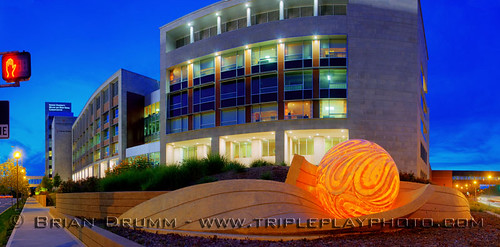
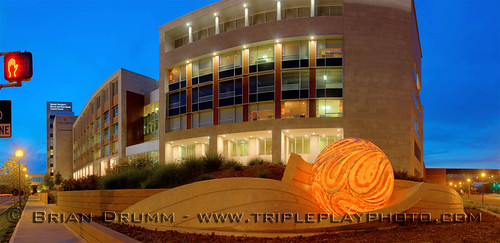
Simon_tungstHere are two more HDR's from last Saturday night, this time of the Melvin and Bren Simon Cancer Center, part of the Indiana University School of Medicine in Indianapolis, IN. In the case of the photo above, I set the white balance on the camera to the Tungsten setting, although often I will set the white balance with a gray card based on whatever weird lighting is on the scene.

Compare that with the version shot with daylight balance below. Both look pretty good, and it's a matter of preference, but I like the heightened contrast between warm and cool colors, as well as the deeper blue sky, in the tungsten version.

Simon_daylight

The software I use to create and tone-map HDR's, Photomatix, does allow adjustment of white balance, but I find that setting rather limited in the range of adjustments. Therefore, I always consider doing multiple exposure series at different white balance settings.

HDR with a little "Strobist" thrown in


East Gate-westate
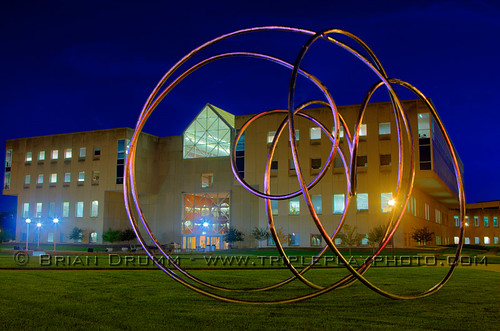
Last Saturday evening, my friend Ron Wise and I did a little exploring on the campus of IUPUI (Indiana University-Purdue University at Indianapois) for some HDR opportunities. I actually had an assignment from the University for some general photos of a few select campus buildings and some sculpture art on extended loan from museums.

One shot on my list was "East Gate/West Gate" a very large (about 25 feet tall) tubular structure that almost looks as though it could have been inspired by and M. C. Escher illustration. One of my acquaintances, who shall remain nameless, described it as "two ampersands in a coital entanglement." (Actually, that's a paraphrase on my part to avoid usage of a certain 4-letter verb which often doubles as an adjective.)

Anyway, where the client was no doubt visualizing a standard daylight photo, I wanted to explore this unique shape under night lights.

The result is at the top.

The building in the background is University Library, and an HDR image preserves detail in the lit interior as well as the exterior shadows. The metal of the sculpture did a good job of picking up the other light sources in the area, but with the camera still on the tripod, I added pops from a gel-ed Vivitar 283 to put some color into the image. Ron was pressing the shutter release and watching to be sure I didn't venture into the frame as I held a Pocket-Wizard-fired Vivitar 283. For these exposures, I used a much shorter shutter speed to capture mostly just the light from the flash and not a lot of ambient light.

I hit it from all four corners in separate exposures with both a red and blue gel, and also with a full CTO, which was effectively white light since my white balance was very close to Tungsten light. In post production, I layered two exposures with the blue gel at camera left and two with the red gel at camera right into a single image with the "Lighten" blending mode. This varied the colors from red to purple to blue. The flash image was layered over the HDR to impart the color onto the sculpture, again with the "Lighten" blending mode.

UPDATE: Here is an interesting video that gives a little information about the East Gate/West Gate sculpture, created by artist Sasson Soffer (1925-1973), and shows the process of moving it to it's current location by helicopter. It includes an interesting aerial tour of downtown Indianapolis.

6.18.2009

Color Me Any Color - Yeah, Let's Gel!


I've stumbled across a few references recently on the web about ways to attach gels to portable flash. Most of the methods discussed are rather rough, referring to rubber bands or gaffer tape. It thought I'd share a way I've found to easily and securely attach gels to my Vivitar units.

090619_gel_1a.jpgThis simple, easy, and cheap method comes courtesy of plastic name tag holders. These are readily available at office supply stores, and many of you have probably packratted away a few of them already if you ever attend or work at seminars, sports events, or other credentialed or "managed access" events. The one's I've used measure about 3 1/4" by 4 1/4". Some have clips to attach to lapels or pockets, others have lanyards. It doesn't matter which you have, because we are only using about the bottom two thirds of the holder anyway (uncut and cut-down tag holders seen here).

090619_gel_3a.jpgFor the Vivitar 285/285HV (seen amber-gelled at right), you will want to cut the holder's height down to about two inches. Try to cut it for a rather snug fit so it does not want to slide out as you hand hold the flash in different positions or, heaven forfend, if you use the flash in the hot shoe and turn the camera vertically. Different holders have different degrees of "flex" so I can't give a precise measurement that will work with every tag holder.

Now, just cut some gels to fit, slide the holder into the diffuser/filter holder built into the 285/285HV, and you're good to go. The gels will be less prone to wrinkle and allow unfiltered light leaks, your gels will last longer, and no tape or rubber bands are needed.

I nip off the corners of the gels so they better fit in the rounded corners of the typical name tag holder. Think of it as releasing your inner Commander Adama.

If you cut the tag holder slightly too narrow and it slides out too easily, or if the holder begins to get some wear on it, a couple of thicknesses of Scotch Magic Transparent across the bottom (as I did on the 285HV gel holder above) should restore sufficient friction to keep it in place without causing you any noticeable light loss. And, sorry, but freebie sample gels are really not large enough for this method. You just may have to shell out for a few actual gel sheets.

090619_gel_2a.jpgMy preferred flash is the Vivitar 283, and this same method works with the 283's accessory lens/filter adapter. I have about six of these and if you don't have one yet, they are available on eBay for ten bucks or less. While you're at it, pick up a lens kit LK-1 (also around ten bucks) so you can concentrate the light where you want it and compensate for some of the light loss from the gels (see red-gelled 283 with "L. Tele" lens at left).

Gel holders for the 283's lens/filter adapter need to be cut to about 2 3/8", but again, this is a guideline. Cut it slightly large, test fit, shave a little more off as necessary for a snug fit.

Are you gellin'? I am SO gellin'.

5.24.2009

The Vivitar 285HV is better than the old 283, right?


If you read my last post, you know I'm in the midst of a "Mission to banish AA's." Experimentation is ongoing, and results will be reported in a day or two. I've already gotten a result that surprised me with the AA Alkalines that is causing me to reconsider my testing method.

In the meantime, a question that might rightly enter the mind of a reader would be, "Why do you use the old Vivitar 283 and not the 285HV, which is readily available new?"

This is a question I have been asked more than once while on assignment. Simplest answer is that 283's are what I have. They last nearly forever, and when they die, more lie in wait on eBay and in used departments of your better camera shops, both brick-and-mortar and online. I think I've owned at least two of them ever since my sophomore year of college. At one point, I had seven of them in perfect working order. These days I have four that work flawlessly, one that works "well enough", and three on the autopsy table for spare parts.

The 285HV is a very good flash. Always has been. I've owned several over the years, but only have one right now. The venerable Strobist has recommended it highly, and I agree. It has the distinct advantage of being a currently (or at least very recently) in-production flash unit, so I assume there is a warranty on new units, and repair and replacement is easier without resorting to eBay.

Another very important advantage to the 285HV is that it has a much safer sync voltage right out of the box. Very important note here: Only the newer 285HV models have the lower sync voltage. Older 285 (non-HV) models you may find on the used market most likely have sync voltage in the 300V range and can and probably will send your 40D or D40 to an early grave, or at least in for an expensive repair.

Two other significant advantages to the 285HV are the zoom head and the variable manual power settings. I will discuss both and indicate why, for me, the 283 is still the better option.

Zoom head: A three position zoom head on the 285HV adjusts the beam angle to cover 35mm, 50mm, and 105mm lenses (based on full-frame SLR viewing angle). This is pretty handy. The 105mm (Tele) setting gives you extra reach for subjects viewed with long lenses at a distance, which is sometimes a necessity. The 50mm (Norm) setting is good for efficient bouncing from the ceiling or from an umbrella. The 35mm (Wide) setting is gives good coverage for general use and prevents vignetting. This setting closely mimics what you get with the 283 with no modifier.

To get the same functionality from a 283, you need the lens kit LK-1 and the Lens Filter Adapter, which holds the LK-1 lenses. Extra accessories are extra dollars, although both are readily found on eBay for about 10 dollars each, sometimes less. The advantage is that the Lens Kit has the ability to vary the angle of coverage to a far greater degree, from 20mm to 135mm. If I need wide coverage, I'm probably bouncing from the ceiling or from an umbrella, but I often use the 85mm or 135mm lenses to increase the reach of a unit placed on a stand in the back of a room or to concentrate the light and allow surrounding areas to go dark (useful for lighting up a speaker in a dark room while still allowing his/her PowerPoint slides to remain visible in the image).

The added flexibility overrides the disadvantage of having to buy and carry extra accessories, in my view.

Variable power: You know, it's nice that the 285HV, unlike the 283, has variable power built-in, but it has LAME variable power built-in. You get 1/2, 1/4 and 1/16. Dat's it. Hummingbird shooters or others interested in extremely short flash duration probably want to tune it down lower than 1/16. Maybe LOT'S lower. And how did 1/8 power get thrown under the bus, anyway?

Again, the 283 is proves to be more flexible, but also at the expense of another accessory. The Vari-power module VP-1 (find it cheap on eBay) allows continuous adjustment of power from Full to 1/64 power. The downside is that, frankly, this is a rather poorly designed accessory. While useful, it has no clickstops or other capability to "lock-in" a power setting. It's just a dial that rotates freely and can easily get pushed higher or lower if the flash is hand-held (not so much an issue for lightstand use). Also, in my tests with several different 283's, you don't actually get 1/2 power at the 1/2 power setting. You need to go down near to 1/4 power to reduce the power by half. So watch your image preview/histogram or use a flash meter to test power settings, and don't assume that adjusting from 1/4 power to 1/8 power is a one f/stop adjustment.

Brave 283 hackers can use various Radio Shack potentiometers or resistors to gain control over the power setting as well. That's fodder for another post.

On thing I dislike about the 285HV: I don't use the color coded auto modes very much, but sometimes they are the handiest way to easily and automatically fill in the foreground of a multiple light set-up. The 285HV gives you 4 modes to choose from. At ISO 400, the corresponding apertures for these modes are 4.0 (yellow), 8.0 (red), 16 (blue) and 22 (purple). Blue and Purple are pretty much useless if your working distance exceeds about 4 feet, so that leaves Red and Yellow. Yellow requires f/4.0, which is just a bit too wide for my taste. 5.6 gives me just a bit of extra depth of field and is more comfortable for me. My next option with the 285HV is red mode, which calls for f/8.0. That's not bad, but the red mode consistently overexposes with my unit, so it's more like f/11. That's a 3 f/stop jump and dumps a LOT more flash power, leading to longer recycle times and more dead batteries.

Behavior of my five 283's is consistent across the board, but I have no way to be sure if my sole 285HV is normal or "special."

The 283's bottom two modes are f/4.0 (yellow) and f/5.6 (red), and are both consistent with their respective apertures in exposure. This is my personal preference, but "red mode" on the 283 is a better fit for the way I work than any mode on the 285HV.

5.21.2009

Mission to banish AA's, part I


I truly HATE AA batteries.

I frikkin' hate them with a PASSION.

The treehugger in me hates them because I have to collect them in a milk jug and unload them for proper disposal at a special recycling event that only happens twice a month in these parts.

I hate them because they cost money. And any and all cost savings are vital in this economy.

And most importantly, as a professional photographer, I hate them because the performance sucks. I get approximately 30 to 40 good flashes with decent but far-from-stellar recycle times before the flash unit begins to slow to an annoying degree. I hang with a set of batteries for 20 or 30 more flashes to get my money's worth or until recycle times begin to put me in serious danger of missing a "money" shot. Then I break out another 3 dollars worth of batteries, fumble with an awkward exchange, and start all over.

The Quantum 1 battery is an obvious solution. Quality flash performance for about 120 to 170 flashes (or perhaps MANY more, depending on how you flash) and then take it home and recharge practically for free. But there's that awkward cable going down to your belt. It gets pinched in my rotating flash bracket. It ends up caught on the petals of my lens shade and is visible in the picture. It beats AA's, but still has it's annoyances.

In a "There's got to be a better way" Google search, I turned up a pre-wrapped, pre-wired five-AA NiMH cluster intended for radio control model airplane servos. I found a pair of such packs rated at 6V and 2300mAh on eBay for about $15 including shipping. Even if this works well, there will still be days I need to use the Quantum 1 for extended shooting without fussing with battery swaps, but I thought these units would be worth a try for shorter, lighter assignments.

A little research in RC model forums confirms my assumption that the five cells in this cluster are 1.2 volts each to make up the 6V usually found in a set of four 1.5V AA's. Obviously this cluster will not fit in the usual battery compartment on my Vivitar 283's but a Quantum style "battery replacer" module can't be hard to whip together.

I'm going out on a limb a bit by posting a blog entry on this experiment which, for all I know, will be an abject failure. But hey, the failures teach us too, right? This will be the first of at least two and possibly three posts on the subject. My immediate challenge now will be to find a way to charge the packs and adapt them for use in the Vivitar 283 (should be easy enough) and to test the performance. If that goes well, I will document a mod I'm planning to the 283 that will allow quick and easy transition from powering the flash with this battery pack to powering it with the Quantum 1.

I may then follow with a couple of related posts on topics like "Why the 283 and not the 285, which is readily available new?" and "OK. You've convinced me to go with the 283. How do I keep it from destroying my digital camera?"

Stay tuned.

2.24.2009

Misused photography terms that bug me


I try to keep my impulses to correct other people's grammar and diction on a pretty tight leash, but there are two words in the photography world that I hear misused a LOT. And it bugs me.

Sorry, but I am about to vent.

"STROBE" - Arguably the best photo lighting blog on the 'net is the STROBIST blog. I'm not knocking anything about this blog. At all.

Except the name bugs me.

The Strobist has a built a great brand and appears to be living the dream of a monetized blog. It would be stupid of me to suggest or for the Strobist to ponder changing the name. But he's not talking about strobing.

"Strobe" is short for the word "stroboscope." This, by definition, means a series or short, bright flashes of light at intervals which can be used to record movement of an object, or to make a rotating object appear to be stationary, such as with an automotive timing light. There is a rather famous photo of a golf swing recorded with strobe, with the club seeming to make a sort of peacock fan around the golfer. In the 1970's, strobes were also used to illuminate the spastic gyrations of dancers wearing hideous clothing in places once referred to as "discoteques."

So, what the strobist writes about is "portable electronic flash photographic lighting." But, of course, "Portable Electronic Flash Photographic Lightingist" would be a crappy name for a blog, so forget it.


090224.png

"PRIME" - In recent years, photo related internet discussion groups and forums have lit up with discussion of the pros and cons of fixed-focal length (non-zoom) lenses, which way to many people insist on calling "primes." There is such a thing as a "prime" lens, but most lenses people refer to as primes, aren't.

The prime focal length, as I can recall from Joseph Costa's Advanced Photojournalism class back at Ball State University, is the lens focal length which will closely reproduce a person's normal field of vision. That is, objects viewed through a prime focal length lens do not appear to be closer to the viewer or farther away. You can calculate the prime focal length for various film and digital sensor formats thusly:

Square root of ((width of sensor/film format squared) plus (height of sensor/film format squared))

Examples:

Prime focal length for 35mm film or FX (full-frame) digital sensors (24mm x 36mm):

(24*24) + (36*36) = 1872, square root of which is 43.27mm. Of course, 50mm is generally considered to be "close enough" to prime for this format.

Prime focal length for APS-C digital sensors, such as Canon 40D (22.2mm x 14.8mm):

(22.2*22.2) + (14.8*14.8) = 711.88, square root of which is 26.68mm. Sigma markets their 30mm ƒ/1.4 lens as a "prime" for this sensor size. Personally, I'd lean toward the Canon 28mm ƒ/1.8, since it would be usable on all EOS cameras.

So, a 50mm on a Canon 5D or Nikon D3/D700 would be considered a prime lens. The same lens on a Canon 40D or Nikon D300 would not be a prime, but a short telephoto. Likewise, a 28mm/30mm lens on a Canon 40D/Nikon D300 would be a prime, but on the Canon 5D or Nikon D3/D700 would be a wide angle.

A 300mm, although not a zoom, is also not a prime lens unless you happen to be using it on an 8"x10" view camera.

I can actually accept using "strobe" as a slang-ification when referring to single-pop flash lighting. I've been guilty myself of making reference to "strobing the IUPUI natatorium for a college swimming meet."

But I have to hold the line on "prime."

2.17.2009

Big doin's at PocketWizard


There was some chatter on the Paul C. Buff forums recently that PocketWizard would make a big announcement soon. Like I usually do when I hear such a thing, I religiously checked their website for several days and when I keep seeing same old same old day after day, I gave up checking one or two days before "THE EVENT." (Seriously, I must have pinged the Canon website for 60 consecutive days, but gave up on it exactly two days before the 5D Mark II announcement.)

The event in this case is the announcement of the MiniTT1 transmitter and FlexTT5 tranceiver radio flash triggering devices. The news here is that these units allow TTL flash operation over wireless RF channels, which will be much more reliable than the about as expensive but dicier infrared wireless systems marketed by Nikon and Canon. For starters, this system is for Canon only, but Nikon-compatible gear is on the way. I won't re-hash features of the units here, as they are covered very well at the Strobist blog.

Personally, I've never been particularly happy with the consistency of results I've gotten with TTL flash equipment. Being an old hand (a VERY old hand) with manual operation of Vivitar 283's, I'm more pleased with the results I get working in "old school" manual. Therefore, I nearly said "big deal" at the news and went on with my day.

But, fortunately, I read on.

These units have the capability of operating in what is called "Hypersync" mode. This is of high interest to sports shooters like myself because it MAY allow using higher flash sync speeds with studio flashes triggered by these units. The power of my AlienBee's B800 units are "just enough" for some of my arena lighting situations, so the ability to cheat the shutter speed upward to cut out a little more ambient light could prove huge in certain situations, such as the IUPUI Natatorium (below).

The manual for these units says mileage may vary with different flash equipment and different cameras. Therefore, I will need to finagle a test situation to figure out if I can squeeze, for example, 1/400 or 1/500 sync speed with my Canon 40D (1/250 stock sync speed), but every single click upward on the shutter speed is a win-win in helping to cut back the ambient light to eliminate ghost imaging in arena situations. And if I read the manual correctly, it will work my my existing PocketWizard Plus II's. This is extremely cool, as it will keep the cost of adoption down by only requiring me to purchase a MiniTT1 transmitter. I may be interested in a FlexTT5 tranceiver later, but that can wait since my interest in TTL operations ranges from limited to non-existent.


2.16.2009

Dear Canon: Your AEB sucks.


I've been an HDR (High Dynamic Range) photography enthusiast for about a year now. Having now done hundreds, or may be even thousands, of bracketed exposure sets, I'm always on the lookout for ways to reduce the tedium of this exercise. Auto-exposure bracketing would seem to be the answer, but, if this post can be seen as an open letter to Canon, Inc., I would have to begin it thusly:


"Dear Canon,

Your Auto Exposure Bracketing sucks."

For cameras other than the EOS 1D's, (like my 5D and 40D) one can set bracket inervals up to two f-stops for up to 3 exposures. This is sufficient only for what the book I consider to be the Bible of HDR imaging calls "MDR," or medium dynamic range. It's sufficient for many of the images I have taken (including the one that serves as the banner to this blog), but certainly not all situations. The pro-level Canon 1D mark III will do up to 7 exposures at up to 3 f/stop intervals. That's much better, if you can afford the price of admission.

I was frustrated enough with the lack of Canon bracketing options that I looked into Nikon cameras. (Switching to Nikon is not something I would seriously consider for multiple reasons, but I looked anyway.) Sadly, Nikon's AEB features didn't strike me as being much better. The Nikon D300 and D700 (to name the only two cameras I have looked at), do up to 9 exposures at up to 1 f/stop intervals. Bracketing over the 9 stop range would be great, but the 1 f/stop interval limit would not be my preference. I've found that 2 f/stop bracket intervals is quite sufficient for HDR work, and the 1 f/stop intervals from the Nikon would fill up my card with a lot of data that I would never use.

There are a few possible workarounds to this:

One option would be to connect the camera to the laptop via USB cable and control it that way. I suspect the brackets could be automated, either in the Canon EOS Utility software or via other means using the Canon SDK (software development kit). I "applied" to receive the SDK last Friday, and haven't yet been notified if I will be one of the "cool kids" and be granted download of the kit. Another open question is whether I will be able to figure out how to actually make the SDK do something more constructive than take up hard disk space. I am a scripter (using AppleScript), but am by no means a software engineer.

But even if I can get an SDK solution to work, I'm not sure at all that I want to lug a laptop around while I shoot, which I sometimes do in inclement weather. Seems to me that would just be a different kind of hassle, not a solution to the the problem. So let's leave this idea aside and proceed to. . .

Arduino.

This is something I just learned of recently thanks to the This Week in Photography podcast. Arduino is a small circuit board that can be programmed from your computer when connected by a USB or serial cable and running a programming environment on Mac, PC, or Linux. I was briefly enthused by this idea, described here, which makes use of software, called Bracketmeister, engineered by a highly skilled photographer named Joergen Geerds (his blog, his portfolio). But then I realized that it operated the camera in "Bulb" mode, which means shutter speed accuracy at speeds shorter than 1 second would be dicey at best, if even possible. Many of my brackets run up into the 1/8th second range, and there is one lighted bank sign on the Indianapolis downtown skyline that is so bright it can take up to 1/60th second to keep it from burning out. (Thanks for that, Fifth Third bank.)

The Arduino board is interesting to the budding electronics geek in me and I will probably mess with it at some future time for another purpose, but it does not seem like the preferred solution for my bracketing needs.

Another possible solution I know I am not the first to think of would be using iPhone or iPod Touch as a handy, portable device for camera control. But my understanding is that these devices are "locked out" of any kind of tethering operation with non-Apple devices. And again, this would probably require programming chops I do not possess, this time with the Apple iPhone SDK.

So, for now, it looks like I'm limited to counting the clicks on the shutter speed wheel in the dark. The best approach I've found thus far is to use a combination of AEB and manual adjustments.

Here are the particulars: My cameras are set to vary the exposure settings in 1/2 stop intervals instead of the default 1/3 stop interval. This gives me the most exposure variation "per click." I first determine the minimum shutter exposure that I plan to use for my brackets by reducing exposure until the brightest area of the image no longer flashes a highlight warning on the LCD. Then I set up AEB at 1.5 stop intervals, and slow the shutter speed down by 3 clicks. This gives me a 3-exposure set with my pre-determined minimum exposure at the low end. This is not yet a high enough exposure range, of course. So I then slow the shutter speed by 9 more clicks of the Tv wheel and do another 3 exposure set. This results in 6 exposures at 1.5-stop intervals for a 7.5 stop range.

That's still more clicks than I like to count, and results in touching the camera on the tripod more than I would like. But it does yield the broadest exposure range for least tedium of any method I have found so far.

2.04.2009

Not quite early enough


We had a refresher coat of snow yesterday, so I thought I'd get an early start to try to take advantage of it for some photography. Seems I didn't quite start early enough. It was amazing how backed up traffic can get even at 6:40 AM. The route I can usually drive with only two or three stops today made me wait through at least 7 extra stop light cycles, costing me a good 10 minutes. It would have been nice to have that extra 10 minutes at my destination, which was one of my favorite views of the Downtown Indianapolis Skyline on the West side of the Canalwalk.

This photo is an HDR stitched together from 5 images and was shot with my Canon 40D and 24-105mm f/4.0L IS lens. The snow looks pretty fresh, but there were some footprints and the canal walk was probably plowed off yesterday. I'd love some fresh undisturbed snow, but the timing for that is rather unlikely for the sunrise view I prefer.

I'm pleased with the image overall, but I'd have liked to have been there a little earlier when the street lights were more in effect. Also, the sky was completely lacking in any kind of cloud activity, and that would have really added some pop and texture.

Click the play button below to take a tour of the image.

1.08.2009

They conceal information like that in BOOKS!!


I have on more than one occasion ragged on my friend and occasional shooting buddy Ron Wise to "pour yourself a seasonally appropriate beverage, ensconce your pooper in a comfy easy chair, and READ YOUR DAMN MANUAL!!"  We'll be out shooting something and he'll be fiddling with menus trying to do this or that and I show him the easy way to get there. This sometimes results in a V8-style forehead slap on Ron's part.

Well, this morning, I followed my own advice and dusted off the manual for my Canon EOS-5D for a refresher on, among other things, a few custom functions whose exact purpose had faded from memory. I discovered (rediscovered?) a nifty thing in the 5D's custom function menu. Custom function 13 allows you to specify how you manually select AF focusing points. Being a fairly dedicated manual focuser, I don't do a lot of that, but it does come in handy from time to time. Maybe I'm shooting an extended session where the subject will always be in the right hand side of the frame. Just choose a focus point in the right hand side and leave it there. Simple.

But the default selection method is just a little bit of a pain. Press the AF point select button and rotate the command dial until the point you want lights up in the viewfinder or on the top LCD. Easy enough, I suppose, but it does require re-allocating cerebral resources I'd rather devote to composition, focus, and timing. Using custom function 13, option 1, I can now use the multi-controller (the little joystick thingy just above the command dial) to choose my AF point. Just push it in the direction of the point you want to use and it's selected. No more multiple clicks of the command dial to get from a side point back to the center.

This is pretty sweet and I can't believe I used the 5D more than two years without knowing this. For users of the 40D (which is actually the camera on which I'd be more likely to do this), the equivalent custom function is in Set III (Auto Focus/Drive), function number 3, option 1.